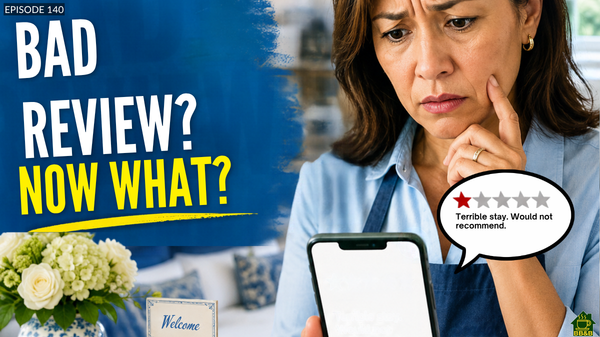
Learning how to respond to Google reviews can help protect your Bed & Breakfast from one negative guest experience becoming a reason for future guests not to book.
A calm negative review response can also show potential guests that if something goes wrong during their stay, they will be treated with care rather than defensiveness.
.
One Bad Review Can Hijack Your Morning
You know that feeling.
Breakfast went well.
The rooms are ready.
Guests seemed happy.
Then you pick up your phone.
There it is.
Two stars.
And a paragraph you really wish you had not read before your second cup of coffee.
Suddenly, the twenty lovely reviews sitting underneath it seem to have vanished.
Did we really disappoint them?
Will other guests believe this?
Should I reply right now?
That last question can get you into trouble.
Because learning how to respond to negative reviews is not really about winning an argument with one unhappy guest.
It is about what happens next.
And sometimes the smartest thing you can do next is put the phone down.
.
Hi, I’m Gerry MacPherson.
I’ve spent more than 30 years around hospitality, tourism, hotels, and guest experiences.
Today, through Beds, Breakfast & Business, I help independent B&B owners build stronger guest experiences, smoother operations, and businesses that create fewer sleepless nights.
And guest reviews are one of those subjects that can definitely cause a sleepless night.
Especially when you care deeply about what you do.
.
Over the next few minutes, I want to show you three things.
How to separate useful guest feedback from personal preference.
How to respond to Google reviews without sounding defensive.
And how to recognise when a negative review is actually pointing towards something in your B&B that could be improved.
By the end, you should feel calmer about bad reviews and much clearer about what deserves your attention.
.
Don’t Read a Review Like a Defendant
Here is where many owners get stuck.
They read a bad review and immediately start building their defence.
That’s not what happened.
They never mentioned that while they were here.
No other guest has complained.
And I understand why.
Your B&B is personal.
You may have prepared their breakfast, welcomed them at the door, answered their questions, cleaned their room, and recommended somewhere for dinner.
So a bad review can feel less like business feedback and more like someone marking your personality out of five.
Instead, try something different.
Read the review like a detective.
A detective asks questions.
What actually happened?
Is there useful information here?
Has anyone else mentioned the same thing?
That small shift helps move you from emotion to information.
For example, suppose one guest says breakfast starts too early.
That might be useful to know.
But it does not automatically mean you should change your breakfast hours.
Now suppose six unrelated guests mention the same thing over three months.
That deserves a closer look.
Same review topic.
Very different meaning.
.
Use Praise, Preference and Pattern
Here is a simple framework I like.
Sort guest feedback into three groups.
Praise. Preference. Pattern.
Praise tells you what is working.
Maybe guests repeatedly mention your breakfast.
Maybe they love the beds.
Maybe they talk about the welcome they received.
Protect those things.
Sometimes owners become so focused on fixing one criticism that they forget the twenty things guests already love.
Then there is preference.
One guest wants a softer mattress.
Another wants a firmer one.
One wants stronger coffee.
Another thinks your coffee could wake a small village.
You cannot rebuild your B&B around every personal preference.
Then there is pattern.
Patterns deserve attention.
If several unrelated guests struggle with parking, your parking instructions may need work.
If guests repeatedly mention a cold room, investigate the heating.
If people keep getting confused about check-in, the problem may not be the guests.
It may be the instructions.
One comment is feedback.
Repeated comments are information.
That distinction alone can save you a lot of unnecessary worry.
.
Your Reply Is Being Read by Tomorrow’s Guest
Here is the part owners sometimes miss.
Your reply to a negative review is not only for the person who wrote it.
Potential guests are reading too.
Imagine someone comparing two lovely B&Bs.
Both have strong ratings.
Both have attractive rooms.
Both look welcoming.
Then they find a negative review.
Now they read the owner’s reply.
They are quietly asking:
If something goes wrong during my stay, how will these people treat me?
That makes your response part of your marketing.
You do not need to prove that you were right.
You need to show that you are reasonable.
That is a much easier job.
.
Use This Four-Step Response
You do not need a three-page response.
In fact, please do not write one.
No future guest wants to settle in with a cup of tea and read the complete legal proceedings of The Guest Versus The Innkeeper.
Keep it simple.
Start by thanking the guest.
You might write:
“Thank you for taking the time to share your experience.”
Next, acknowledge how they felt.
For example:
“I’m sorry to hear that your stay did not meet your expectations.”
Notice that you have not agreed with every claim.
You have simply acknowledged their experience.
Then, if context helps, explain briefly.
Briefly is the important word.
If an unexpected plumbing problem affected the room, say so.
Explain what happened and, where appropriate, what you did about it.
Then finish positively.
Be warm.
Be professional.
And stop typing.
A good response does not need the final word on every detail.
It needs to leave the reader thinking, These people handled that well.
.
What is the hardest part for you when you receive a negative guest review?
Is it deciding whether the complaint is fair?
Writing the reply?
Or simply stopping yourself from thinking about it for the rest of the day?
Let me know in the comments.
.
Fix the Experience Before the Review Appears
There is another way to handle negative reviews.
Catch the problem before checkout.
A simple question at breakfast can do a surprising amount of work.
How has everything been so far?
Or:
Is there anything we can do to make your stay even better?
Imagine a guest has a faulty kettle.
If you discover that while they are still staying with you, replacing it takes five minutes.
If you discover it next Tuesday in a two-star review, you now have a paragraph to write and a reputation problem to think about.
Same kettle.
Very different outcome.
Your review process starts before the guest leaves.
.
Turn Patterns Into Small Improvements
Once a month, look at your recent guest feedback.
Do not begin with the star rating.
Read the words.
Ask yourself:
What are guests praising repeatedly?
Protect it.
What comes up occasionally?
Keep an eye on it.
What keeps appearing?
Investigate it.
This is where negative guest reviews can become useful.
Not pleasant.
Useful.
A review might show that your arrival instructions need simplifying.
Your breakfast timing needs reviewing.
Your Wi-Fi instructions need updating.
Or your parking directions were apparently written for somebody who already knows where the car park is.
You do not need to fix everything.
You need to notice what repeats.
.
Here Are Your Key Takeaways
- Read reviews without reacting
- Separate preference from patterns
- Respond for future guests
- Keep explanations short
- Fix systems, not just reviews
.
In Conclusion
A bad guest review can sting.
That is especially true in a Bed & Breakfast, where your personality, your home, and your hospitality often sit very close to the business itself.
But one review does not need to run your week.
Pause before you respond.
Separate preference from pattern.
Look for useful information.
Then reply in a way that tells future guests, If something goes wrong here, I’ll be treated with respect.
That is the real goal.
Not perfection.
Confidence.
Calm.
And the ability to learn from feedback without allowing one stranger’s opinion to move into your head and start rearranging the furniture.
If you would like some help strengthening the foundations behind your guest experience, download the free Your B&B Starter Blueprint.
It gives you practical steps for creating stronger guest experiences, smoother operations, and a B&B that feels easier to manage.
The Your B&B Starter Blueprint is available through the link in the show notes.
You’ll also find information there about the free Beds, Breakfast & Business webinar if you’d like to go further.
In the next episode, we are going to begin a new series starting with How great housekeeping systems improve guest satisfaction and reduce stress.
If you are interested in more resources to help grow your business, visit Beds, Breakfast & Business.
https://bedsbreakfastsbusiness.com/